If you're researching hi3d for image-to-3D work, this independent test examines Hyper3D Rodin's credit charges and download access alongside a SupaVoxel export. It distinguishes a visible preview from a file that could actually be downloaded.
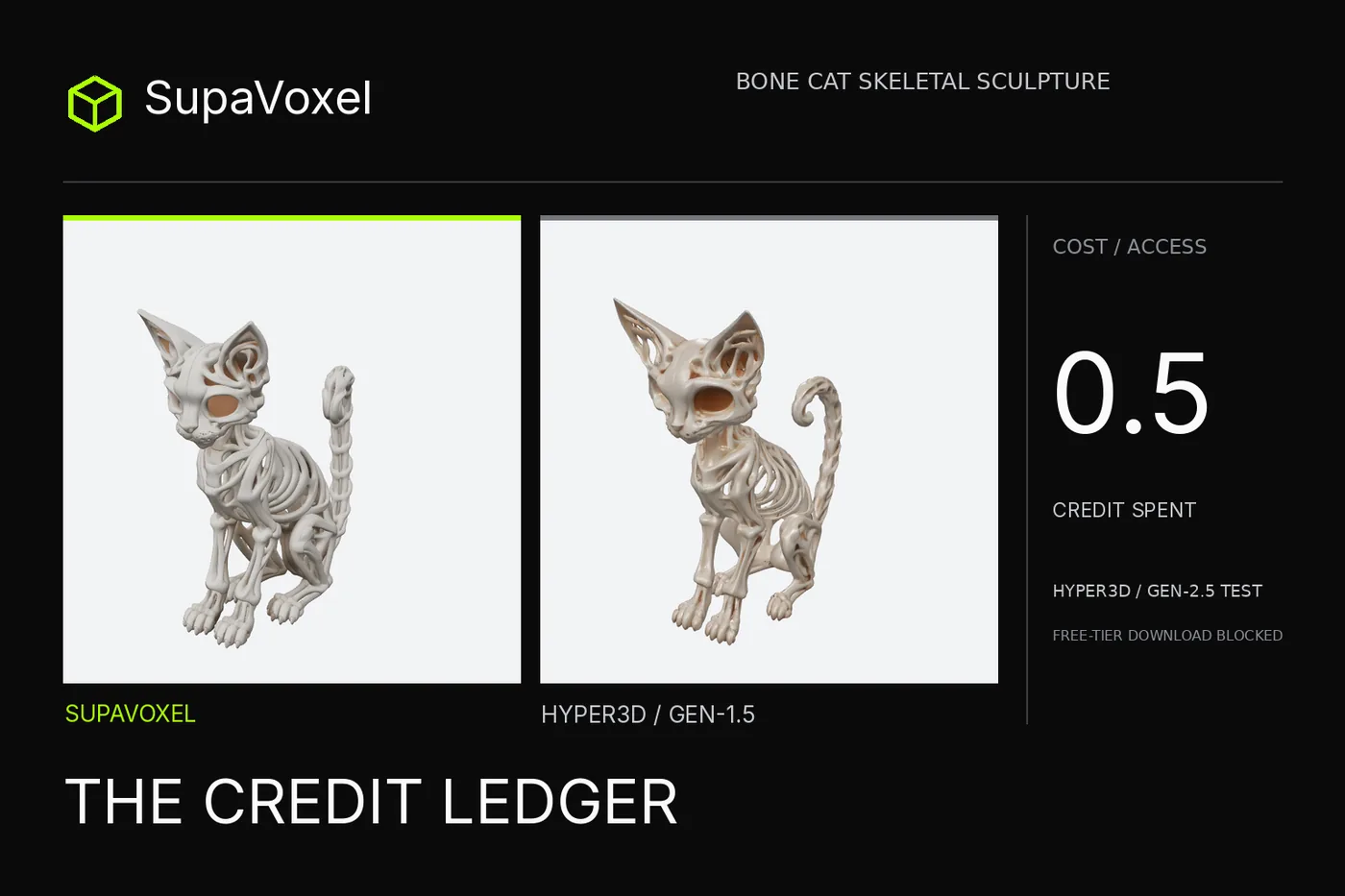
Independent test: everything below ran on my own free and paid accounts, and no vendor provided access.
Half a credit vanished on my first attempt at this cat, and I came away with nothing a modeler could use. Hyper3D Gen-2.5's preview showed the ribs clearly, and GLB was selectable. Only when I hit Download did the free account explain that the file required a subscription. So I started over, generated a different Gen-1.5 cat from the same image, and tracked every balance change far more carefully.
That exact image went to SupaVoxel too, and I got its textured GLB back — but SupaVoxel credits aren't Hyper3D credits wearing another typeface. SupaVoxel earns a place here because this case's transaction can be traced to a file I actually downloaded, not because "3" looks cheaper or pricier than "0.5."
My verdict in 60 seconds — don't treat the Hyper3D Gen-2.5 free-account preview as something you can deliver; in this cat test, Gen-1.5 did produce a textured 2K PBR file for an attributable 0.5 Hyper3D credit. The material stages, checked separately, added no observed credit charge. SupaVoxel produced a 4K textured GLB for a matched 3 SupaVoxel credits, with a simpler direct-GLB handoff. For a low-byte static bone cat where Gen-1.5 is acceptable, Hyper3D takes the cost/access win inside its own account. For 4K maps and the 3MF menu route I observed, look into SupaVoxel, but budget for its bigger file and local mesh defects. Without comparable plans, nobody wins on dollars. Eight paired calls follow, with no made-up numeric quality score:
- First Hyper3D attempt — Gen-2.5 took 0.5 and refused the free Download · SupaVoxel finished a transaction and handed over a GLB. SupaVoxel sidesteps that preview-only dead end.
- Hyper3D route that exported — Gen-1.5 preview first, 0.5 debited on geometry Confirm, PBR ZIP later · SupaVoxel: one 3-credit transaction, textured GLB. Both yielded real files.
- Material bookkeeping — Hyper3D Gen-1.5 balance held at 1.0 before, during and after Generate, and before/after Confirm · SupaVoxel showed one −3 debit tied to the request. Records specific to this case.
- Texture pixels — Hyper3D three 2K PNGs · SupaVoxel three 4K PNGs. Quadruple the pixels per map is not quadruple the visible fidelity.
- First file received — Hyper3D 5.17 MB geometry GLB, 0 images · SupaVoxel 67.38 MB tested Original size GLB, 3 maps. A bare export shouldn't be weighed against a textured one.
- What the download really contained — Hyper3D 23.15 MB ZIP holding two GLBs · SupaVoxel 67.38 MB GLB, direct. Fewer bytes for Hyper3D; no unzip step for SupaVoxel on the tested path.
- Full time-to-file — not recorded for Hyper3D · not recorded for SupaVoxel. The 49.636-second partial phases and the 260.335-second request lifecycle can't be compared.
- Commercial print economics — dollar rate and license not established for Hyper3D · not established for SupaVoxel either. A credit number says nothing about usage rights.
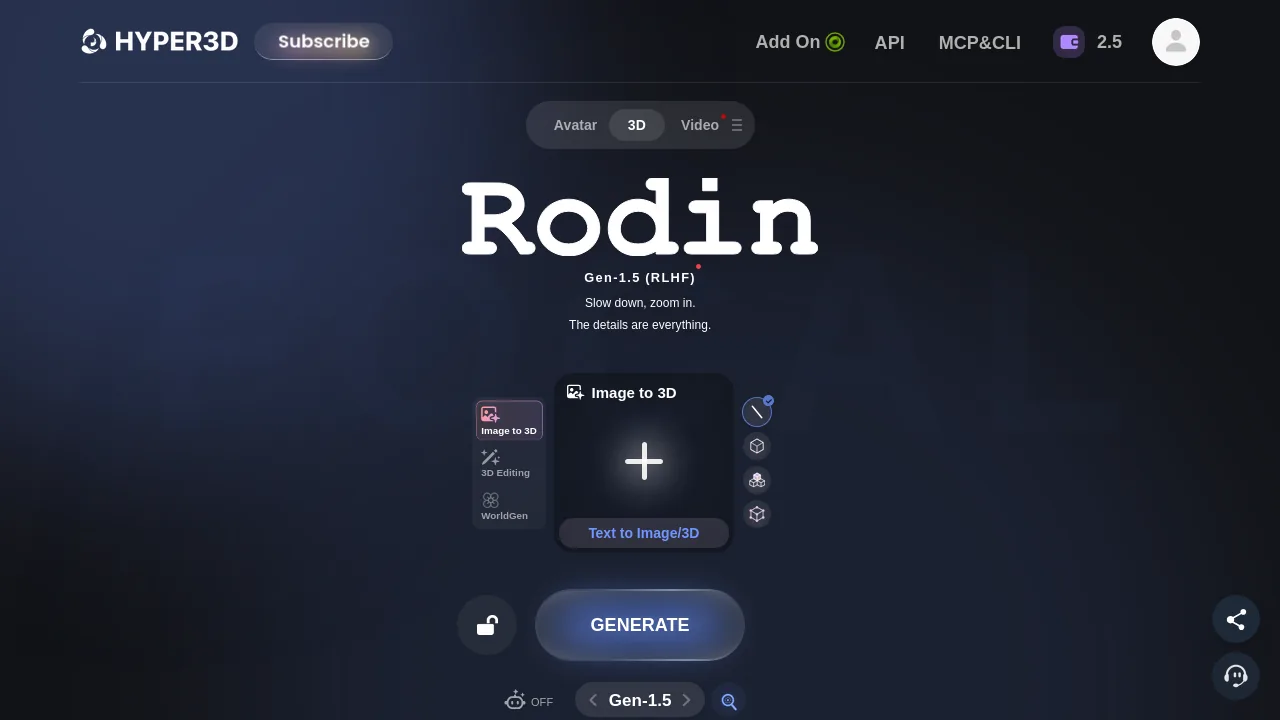
Before Gen-2.5, the free-account Hyper3D header read 2.5 credits; the 0.5 debit that followed belongs to that attempt, not to the Gen-1.5 file I ended up with.
Three routes to one cat
Not three identical paid products but three generation paths: a Hyper3D Gen-2.5 attempt, a Hyper3D Gen-1.5 attempt and a single SupaVoxel run. Each was fed the same 1,702,829-byte illustration of a seated skeleton cat. I confirmed via SHA-256 that the image attached to the SupaVoxel request was the source file. Hyper3D's two paths stored different automatic descriptions and settings, so this is not a controlled comparison where only the version changes.

One cat image, two services. Below, only an actual file counts as a transferable result — never a thumbnail that merely looks familiar.
Gen-2.5: half a credit gone before the Download gate
As the Gen-2.5 preview finished, the free Hyper3D balance went from 2.5 → 2.0 credits — a 0.5-credit debit attributable to this run alone. By the saved task clock the preview took 51.622 seconds, and geometry confirmation another 32.6. The interface listed 1,000,000 faces and 723,700 vertices along with Watertight and Print-Ready labels. Because I never downloaded that Gen-2.5 mesh, those figures are interface claims, not file analysis.
Clicking Download on the selected GLB produced a prompt to subscribe to download Gen-2.5 models, with a note that Gen-1.5 downloads stayed free. By then the 0.5 credit had already been spent. I'm not arguing paid features should cost nothing; the point is the practical cost of discovering the gate after part of a limited trial balance is gone. A freelancer who promised a client the million-face file shown on that screen would still have nothing to hand over on this account's access.
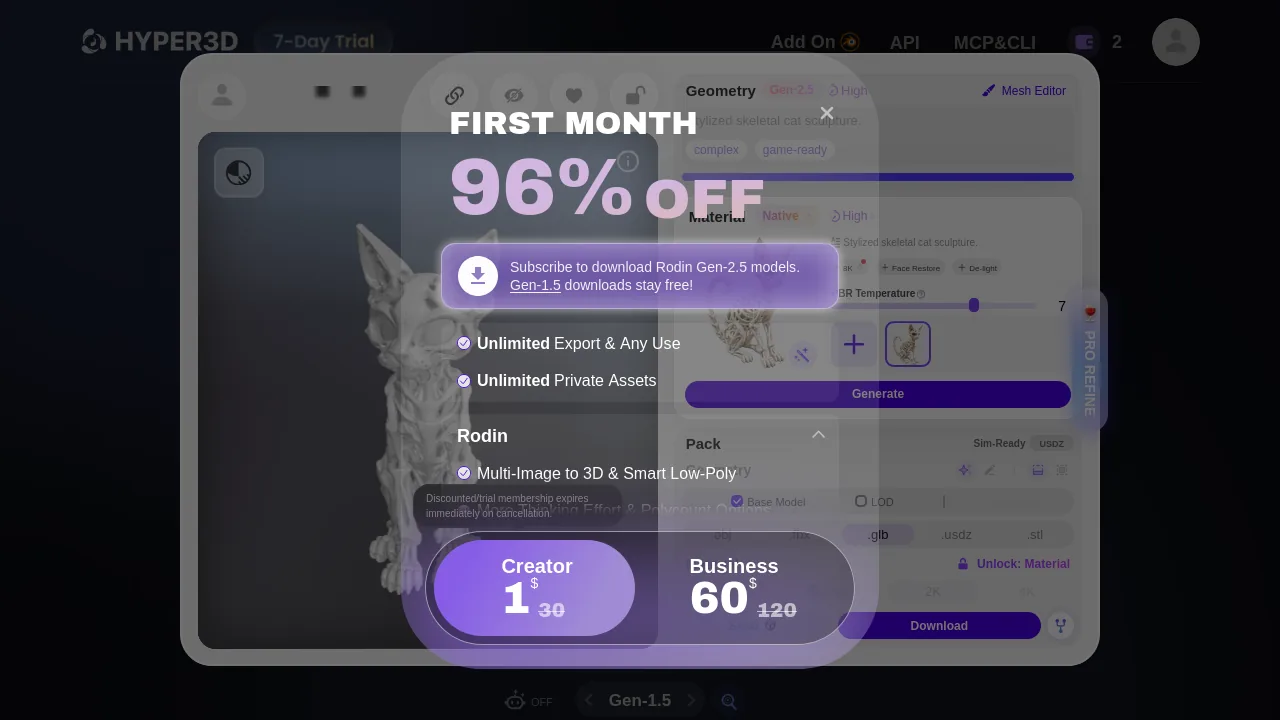
The free-tier refusal came on the real Download click, after the 0.5 debit. None of the Gen-2.5 geometry appears in later comparisons.
Gen-1.5: a free preview, then a half-credit Confirm
Gen-1.5 in Hyper3D started out as a Free Preview. The task clock put the preview at 25.036 seconds; confirming geometry took 24.6 seconds and shifted the balance 2.0 → 1.5. That 0.5 Hyper3D credit charge, verified on its own, sits on the run that later produced the textured PBR file. It neither reversed nor refunded the blocked Gen-2.5 trial; the two half-credit debits total 1.0 across my two experimental routes — not one credit billed for a single Gen-1.5 output.
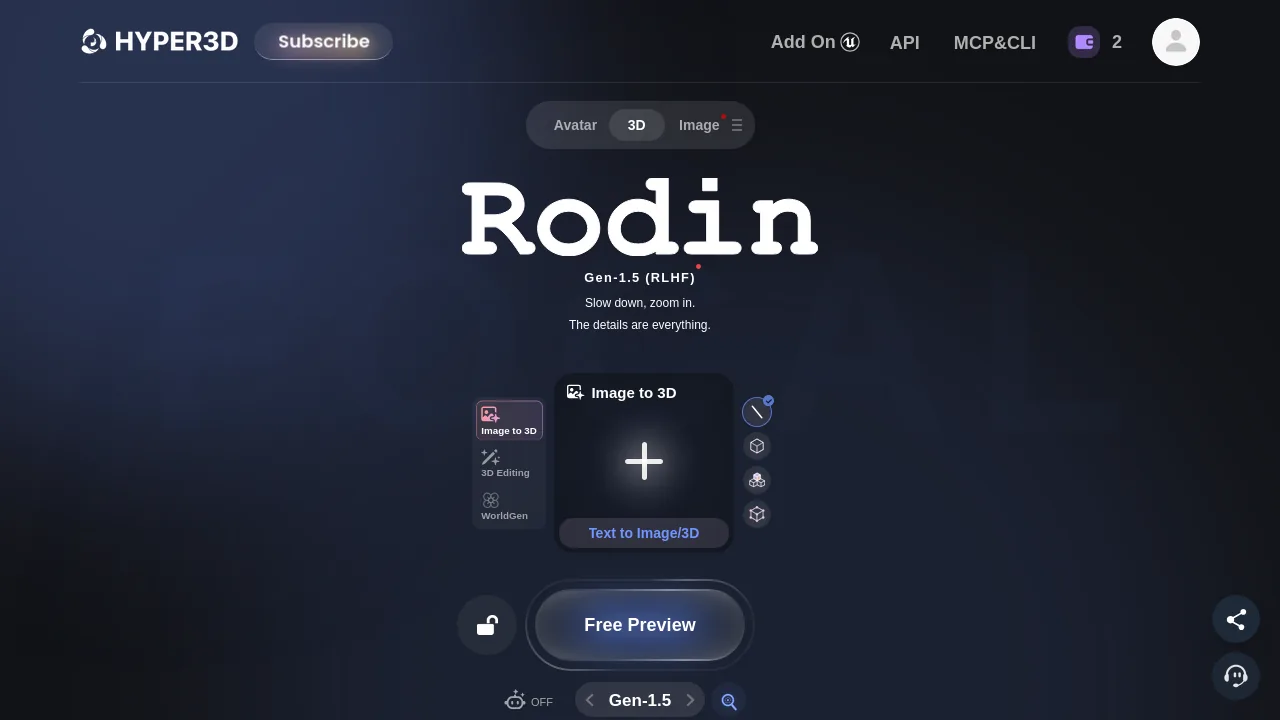
The Gen-1.5 route began with 2.0 credits remaining after the earlier blocked trial; the geometry charge for this route came on Confirm.
The first Gen-1.5 download had no textures
Once geometry was confirmed, a 5,170,468-byte GLB was available to download. The geometry was genuine, but the file held zero embedded images. A product photographer briefed on a textured bone-cat render would reject an untextured shape just because the export button functioned. For that brief, the fair comparison asset is the later PBR model, which embeds three 2048 × 2048 PNGs.
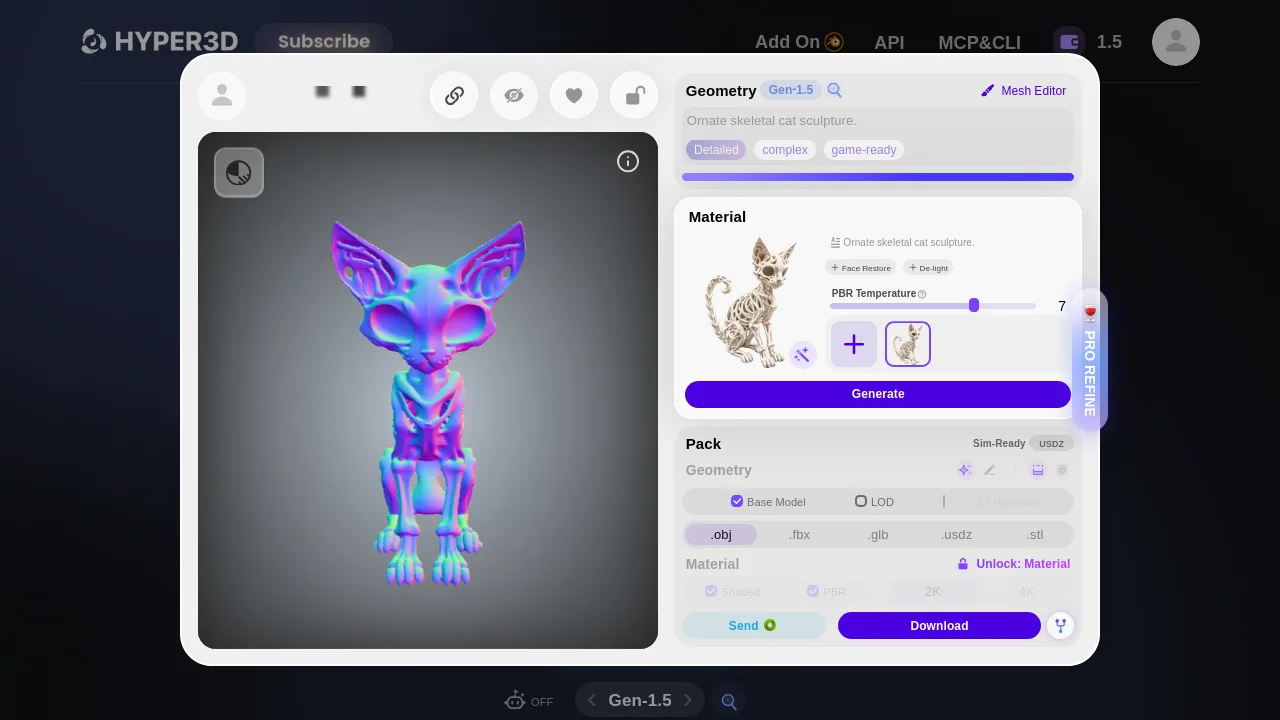
Hyper3D's first export carried geometry only. This Material panel, reached later, leads to the textured comparison file.
Material Generate and Confirm: no extra debit seen
Within the controlled checks I ran around this cat's material steps, no further half-credit left the account. The balance read 1.0 credits before, during and after Material Generate, and 1.0 on either side of Material Confirm. So those stages added zero observed additional credits to this run. Combined with the isolated 0.5 debit at geometry Confirm, the case record supports 0.5 Hyper3D credit chargeable to this Gen-1.5 PBR file.
One wrinkle I won't bury: an earlier movement on the same account, 1.5 to 1.0, happened before the controlled material sequence and couldn't be linked to this cat. I haven't booked it as a material cost, nor does it prove the account never spent it. That's why I cite the isolated stage checks and the file outcome rather than an all-day balance difference. What results is a per-case ledger I can defend, not a universal tariff for everyone pressing Generate.
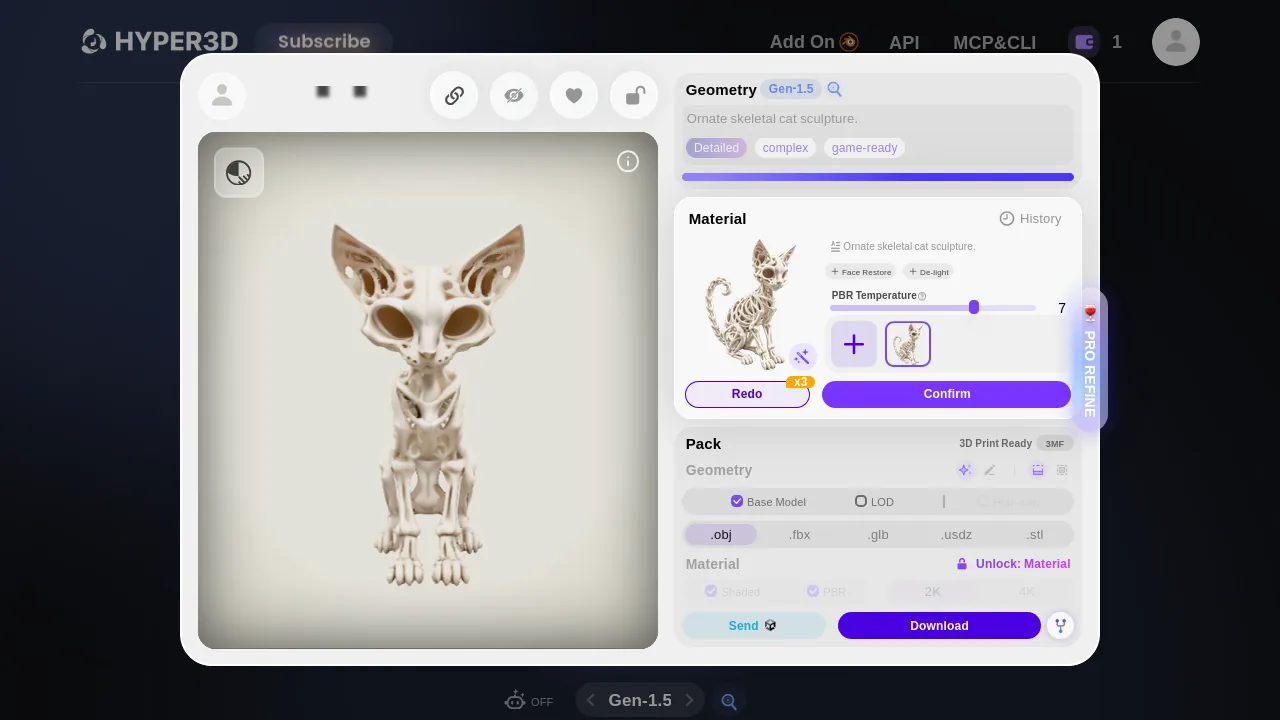
The PBR preview of the cat showed up after Material Generate; the isolated 1.0 → 1.0 balance readings show no extra credit in this task window.
What the Download button really delivered
It sent a 23,151,232-byte ZIP — not the standalone 14,181,040-byte PBR GLB that tends to get quoted as "the Hyper3D download." Inside the archive is also an 8,969,940-byte Shaded GLB. Every file, texture and mesh comparison used the PBR member. Host that single extracted GLB yourself and the payload is 14.18 MB; let a teammate press the product's button and 23.15 MB actually moves, second variant included.
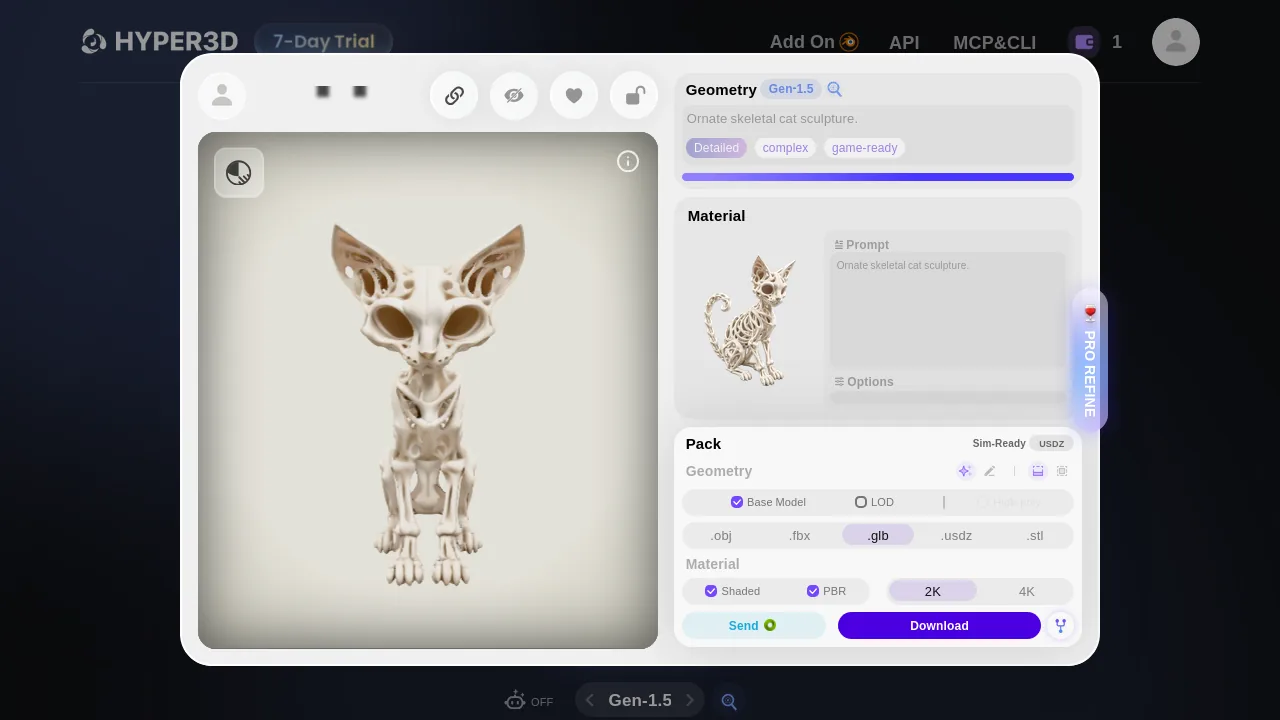
Both PBR and Shaded were ticked in the Pack UI, so the transfer counted here bundles two GLBs into one ZIP.
Tracing SupaVoxel's charge without the shared balance
The shared balance couldn't do it: several cases were running on the SupaVoxel account at once, so any before/after change in the header could belong to another model. Instead, the case linked the identical source image to the specific request and then matched a single debit transaction of −3 SupaVoxel credits to it. The Original size GLB that resulted downloaded fine, held three 4096 × 4096 PNGs and weighed 67,377,036 bytes.
For one finished file, that is a tidy accounting chain: request → transaction → output. What I did not capture is the instant the customer-facing UI showed the debit. Nor can three SupaVoxel credits be set against half a Hyper3D credit in dollars; that would need different entitlements and dollar rates. The question that matters for this brief is whether the 4K asset and the menu choices justify the bytes and mesh-editing work, not whether "3" looks like a bigger number.
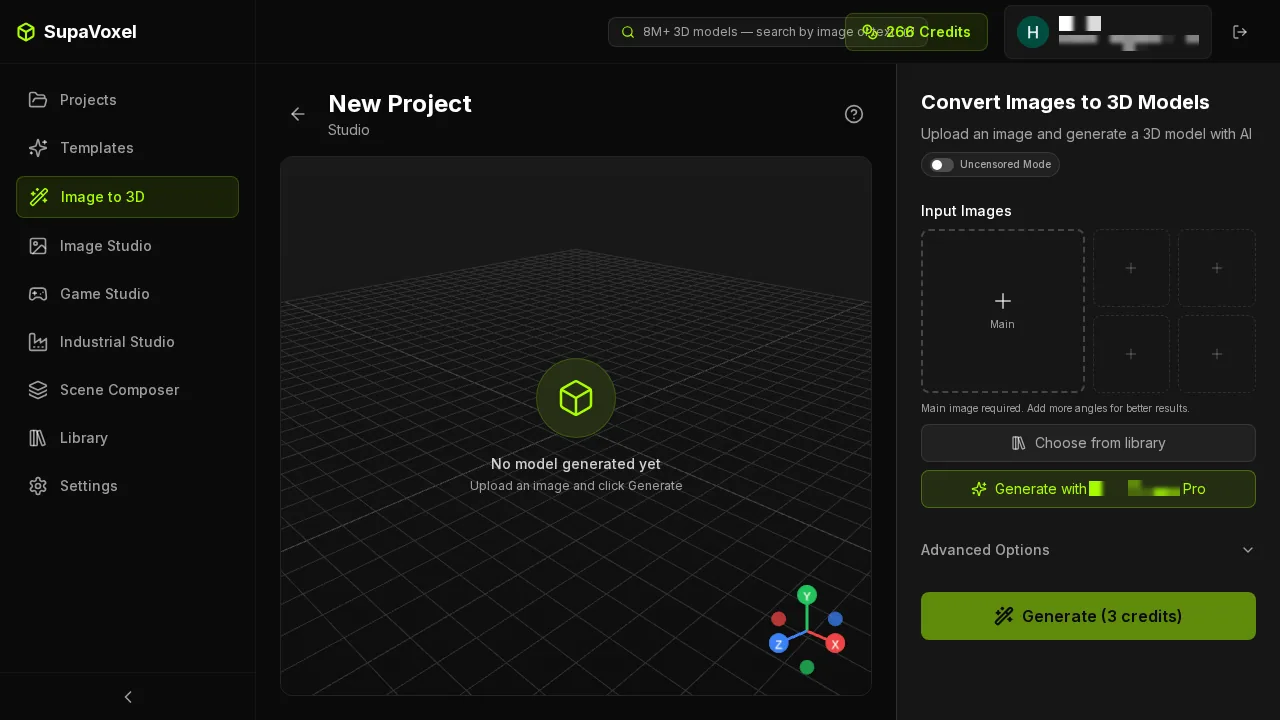
SupaVoxel's page displayed the 3-credit generation price; this run was verified by a case-specific transaction, not by a swing in a shared balance.
Scaling to one hundred paid deliverables
Dollars are out of reach here. If 100 identical Gen-1.5 PBR runs each repeated this cat's isolated stage charges, the Hyper3D ledger would total 50 Hyper3D credits. If 100 SupaVoxel requests repeated this case's transaction, they'd total 300 SupaVoxel credits. Those two numbers imply no exchange rate between the services. The 0.5-credit Gen-2.5 preview detour is charged once to my experiment; it doesn't multiply across every future Gen-1.5 file.
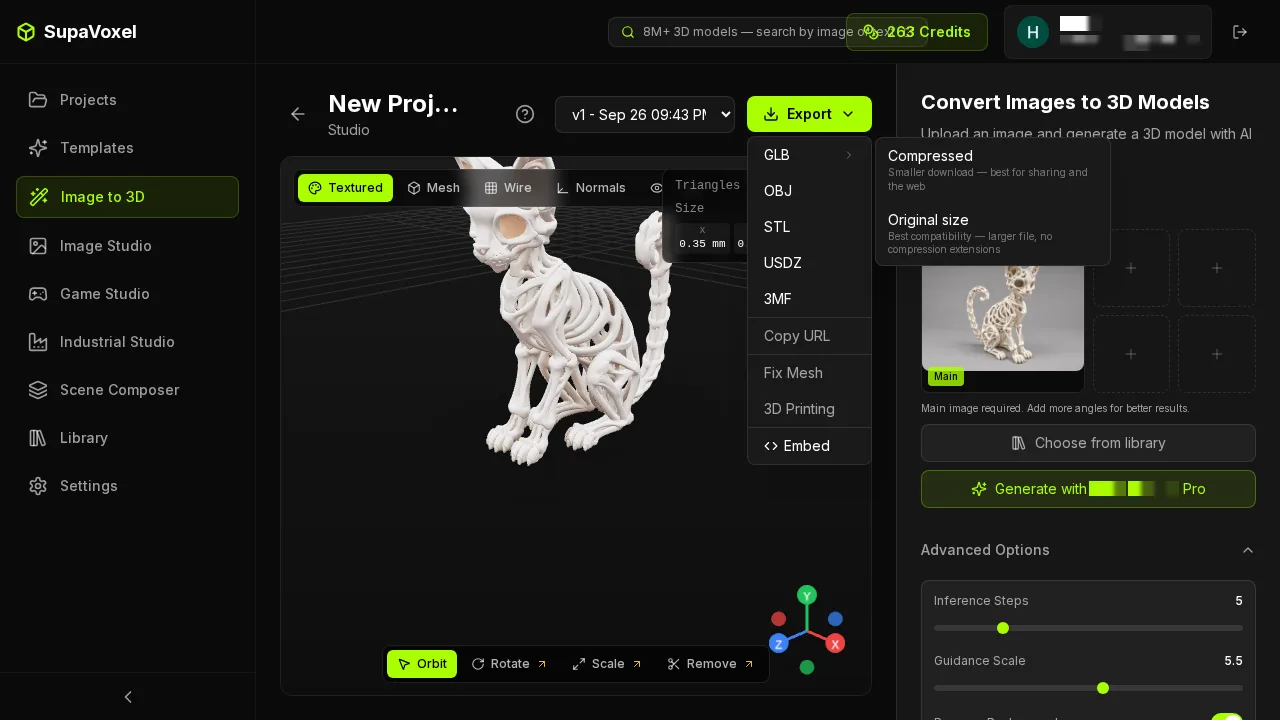
Shown here is SupaVoxel's measured Original size branch; the Compressed option is visible but has no byte count measured in this case.
Two timers, two different boundaries
Neither timer covers the whole path to a file. Hyper3D's 49.636 seconds sums its Gen-1.5 preview generation and geometry confirmation phases; the material stage wasn't fully timed, and uploads, clicks, packaging and download sit outside the total. SupaVoxel's 260.335 seconds is the request's creation-to-update interval, which includes queue time but leaves out the upload before the request and the export after it. With boundaries this different, subtracting one from the other means nothing.
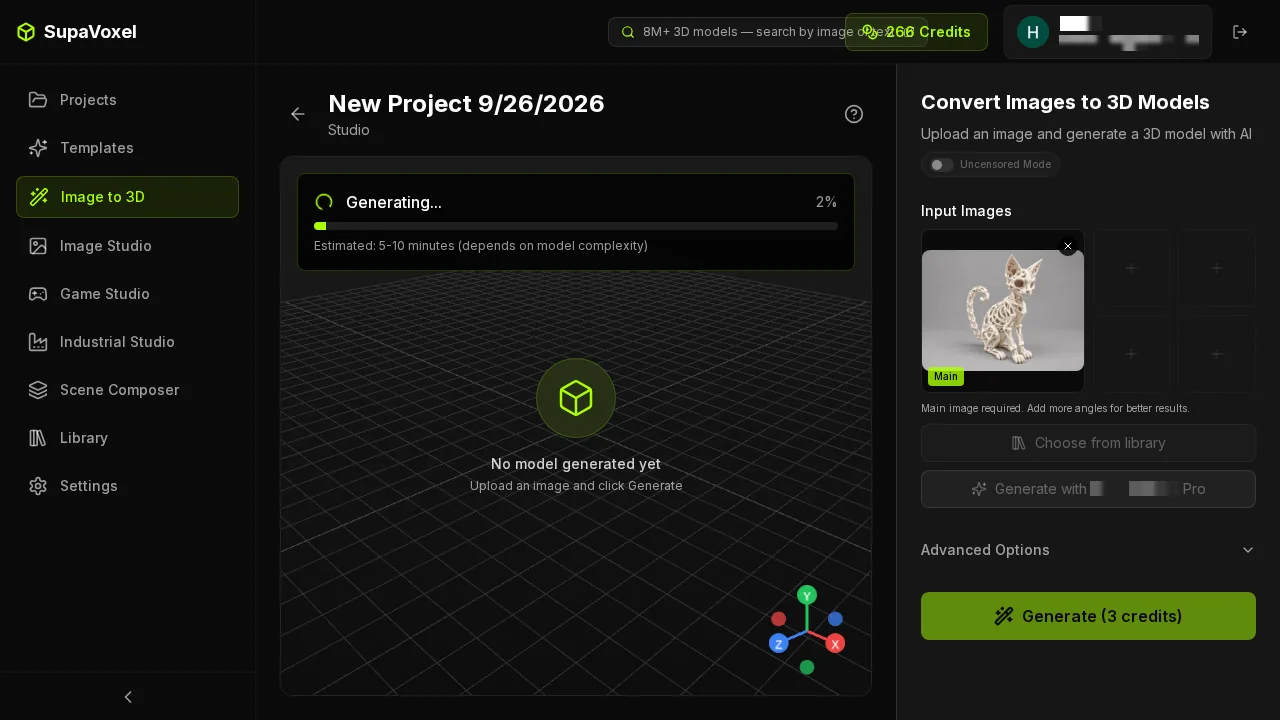
A generating state in the SupaVoxel UI; the 260.335-second figure covers the request lifecycle, not every minute a user spent getting a file.
Hyper3D's real wins in this matchup
For this cat, Hyper3D's Gen-1.5 PBR file is 14.18 MB extracted and visibly keeps finer ribs along the flank and tinier holes through the tail. After welding, each final mesh is watertight and free of nonmanifold edges, yet Hyper3D has 0 degenerate / 249 sliver faces to SupaVoxel's 19 / 7,217. When the job is a delicate static ornament, those file-health and art-direction wins carry weight. If the buyer will show a modest gallery model instead of cropping into a 4K map, the leaner 2K texture set is a sensible trade too.
Switch to SupaVoxel and what do you give up? About 4.75× the extracted PBR file size in this export comparison, plus more triangle inspection. What comes back? Three 4K rather than 2K maps, finer average mesh sampling, and a menu listing 3MF — though the 3MF output itself went untested. If your pipeline needs those, the trial makes sense. If not, Hyper3D's smaller, cleaner model wins this particular spending decision.
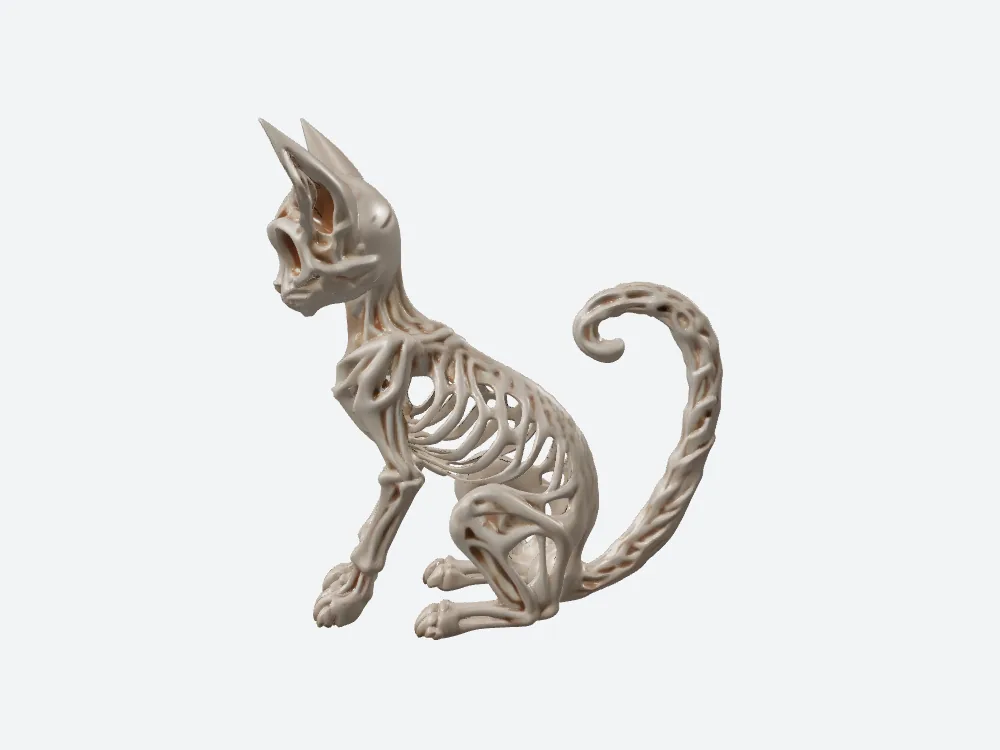
Hyper3D's finer-looking ribs survive in a compact PBR file; a lower polygon count doesn't mean the skeleton detail is gone.
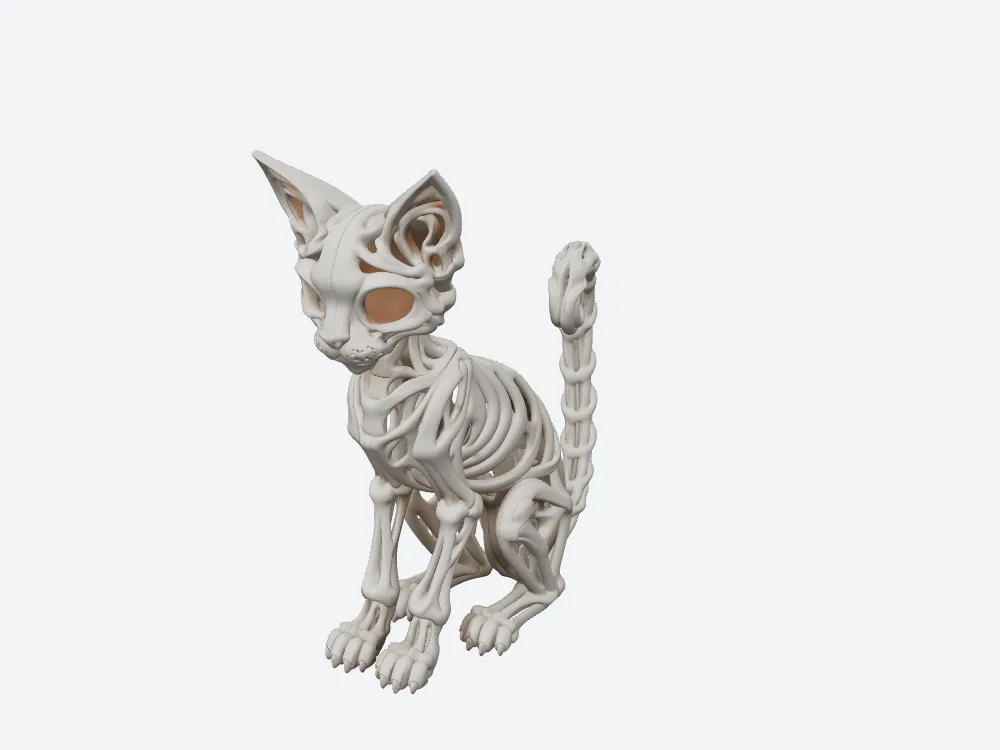
The 4K SupaVoxel cat exports directly but weighs substantially more than the 2K PBR file extracted from Hyper3D.
Final verdict: where my next credits would go
Not into another free-account Gen-2.5 preview in the hope of getting its file. Gen-1.5 produced the actual 2K PBR cat for an attributable 0.5-credit charge on this single run, with no extra material-stage debit seen in controlled checks. SupaVoxel produced a 4K Original size cat for an attributable 3-credit transaction. If I needed 4K inspection or the 3MF workflow on offer, SupaVoxel is what I'd test next; for a lighter static gallery cat, this evidence points me to Hyper3D Gen-1.5. No credit count, on either side, tells me dollar cost, print success or licensing terms.
Which one I would use for this 4K job
When a commission calls for a textured 4K sculpt, or you want to explore a 3MF export, run your cat image through SupaVoxel and check the exact file before you pay for production. In my test the GLB came down directly, carrying the expected three 4K maps and a request debit I could trace. Tell anyone who'll host, edit or slice it about the 67.38 MB Original size footprint and the 7,217 slivers / 19 degenerates. If the smallest measured 2K PBR in this pair is what you need, go with the Hyper3D Gen-1.5 result.
Ledger method and open questions
The same independently generated PNG went into both services: one Gen-2.5 and one Gen-1.5 attempt on Hyper3D, then a single case-identified SupaVoxel run. I captured Hyper3D balances at the specific generation and confirm stages and on both sides of each Gen-1.5 material action; the unrelated earlier 1.5 → 1.0 shift was not charged to this cat. SupaVoxel's single debit was matched to its input-linked request rather than inferred from a shared balance. I did not treat the 49.636-second Hyper3D stage total and the 260.335-second SupaVoxel request interval as a race.
Every MB/GB figure uses decimal bytes; the 12 Mbps scenario is purely a transfer floor. Several things stayed unknown: how paid plans convert credits to dollars, the commercial license, whether trial credit refills, the full time-to-file, the Compressed GLB's size, what a real 3MF file looks like, batch usage terms and repeat reliability.
Originally published on Medium: Hyper3D Rodin Credits Review 2026: 0.5 Credits, Then a Paywall.