For readers searching hi3d, this independent comparison shows what Hyper3D Gen-1.5 preserves in a knitted-vase model—and where SupaVoxel retains more of the photographed cable relief. It also covers file-size trade-offs and mesh issues.
This is an independent test. Nothing here came from vendor access: both tools were used on my own free and paid accounts.
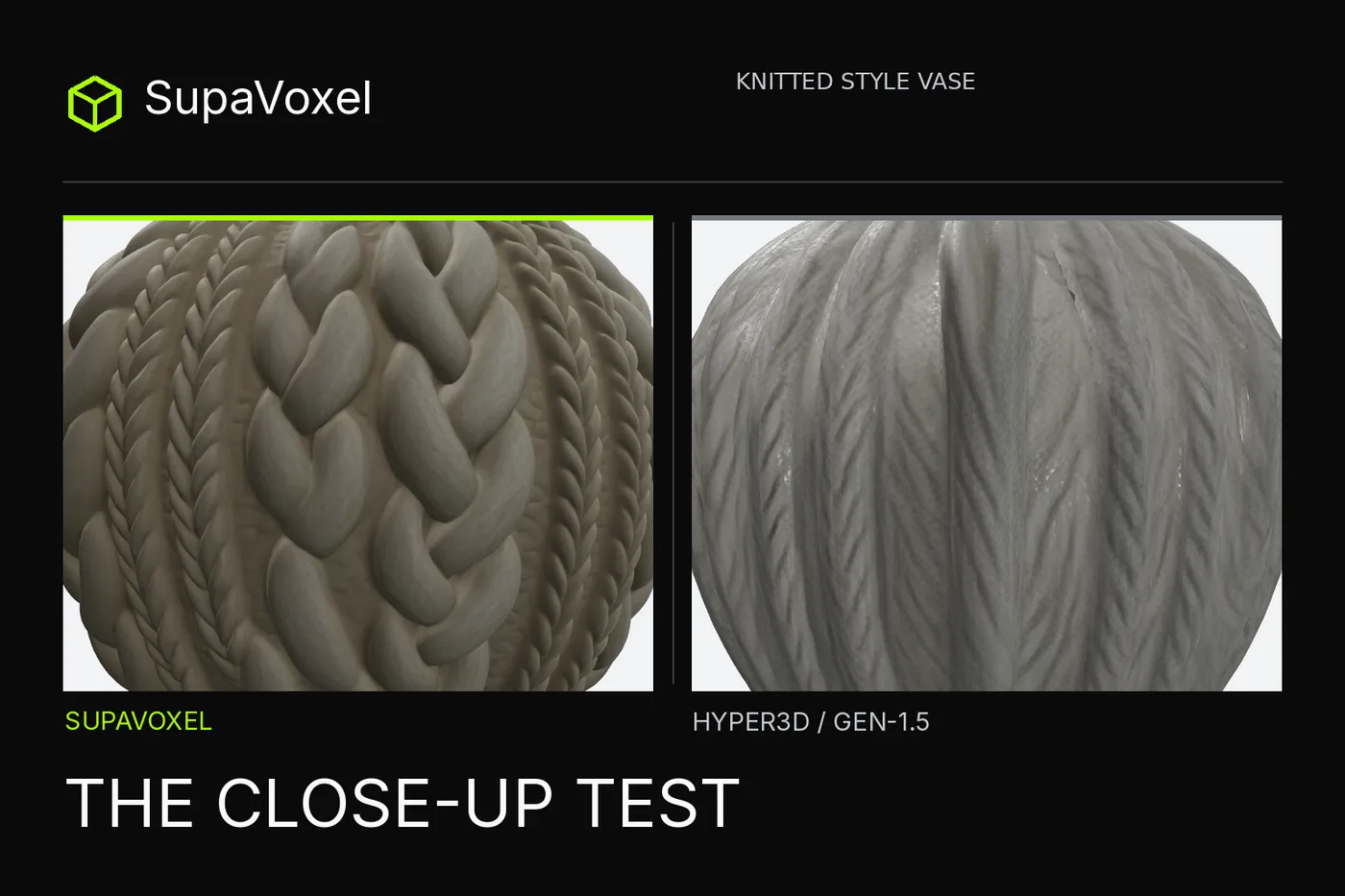
The reference had thick knitted ropes crossing around a white vase. Hyper3D's downloadable Gen-1.5 vase looked persuasive until I switched off the material: most big crossings resolved into tidy vertical ribs. SupaVoxel's much heavier file still showed broad strands passing over one another in clay. If I am delivering a model that must look like this photograph when somebody rotates or relights it, the smaller Hyper3D file is not the whole answer.
My verdict in 60 seconds — SupaVoxel keeps the photographed thick cable crossings in the downloadable mesh; Hyper3D Gen-1.5 trades much of that relief for a smaller, cleaner original file. Both outputs look like vases. In clay, SupaVoxel still has visible over-and-under strands, while Hyper3D's exported geometry reads mostly as straight ribs. The trade is real: 35.05 MB SupaVoxel Original size GLB against 15.87 MB Hyper3D web ZIP, and SupaVoxel's welded mesh still has 744 non-manifold edges. For a digital concept where chunky knit must be geometry I would start in SupaVoxel and budget repair and delivery optimization; for an untouched single-shell starting solid or a small original download I would take Hyper3D. Neither is a tested functional vase.
Eight side-by-side checks, Hyper3D then SupaVoxel:
- Rounded silhouette and mouth — both recognizable; SupaVoxel retains fuller raised surface structure.
- Raised cable crossings — Hyper3D Gen-1.5 mostly straight ribs versus SupaVoxel's over-and-under geometry.
- Unseen rear motif — SupaVoxel continues the invented interweaving; no true rear photo permits likeness scoring.
- Clay-view structure — Hyper3D loses much stitch appearance without PBR; SupaVoxel keeps the thick forms.
- Actual browser transfer — 15.87 MB Hyper3D ZIP versus 35.05 MB SupaVoxel Original size GLB.
- Standalone PBR weight — 10.50 MB Hyper3D extracted member versus 35.05 MB SupaVoxel, if hosting those exact originals.
- Estimated geometry memory — 2.63 versus 27.63 MB under a specified layout, excluding maps.
- Map count and dimensions — a tie at three embedded 2048² PNGs each, not a color-accuracy test.
These checks favor different files for different uses. None silently repairs SupaVoxel's non-manifold junctions.
What did the source actually show?
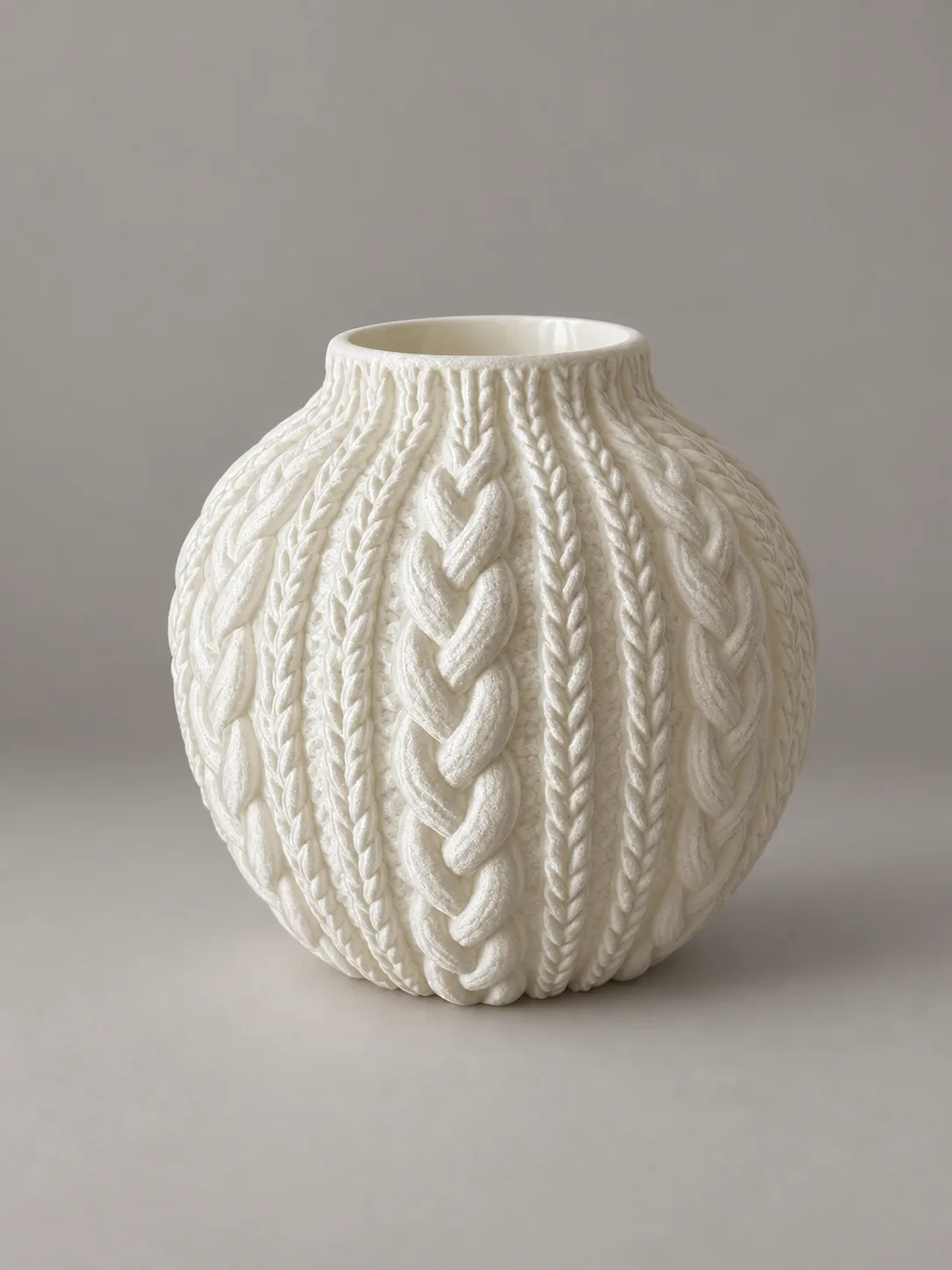
One 1,746,019-byte PNG with large, visibly interwoven white cables. The unseen rear and interior are not documented.
It is not a plain ceramic vase with a little printed snowflake motif. The photograph asks for thick strands with real over-and-under travel. Both products received the same SHA-checked image, although internal cropping and preprocessing were not measured. Hyper3D's Gen-1.5 auto-description mentioned knitted texture; its separate Gen-2.5 caption did not. That caption difference complicates any “same model, different version” theory. The reference image was AI-generated using a third-party cover as visual inspiration; neither this analysis nor the file establishes publication rights over the underlying cover. Here I assess the assets the tested accounts could actually obtain, not a claim to reproduce a commercial original.
Did Hyper3D keep the main feature from the front?
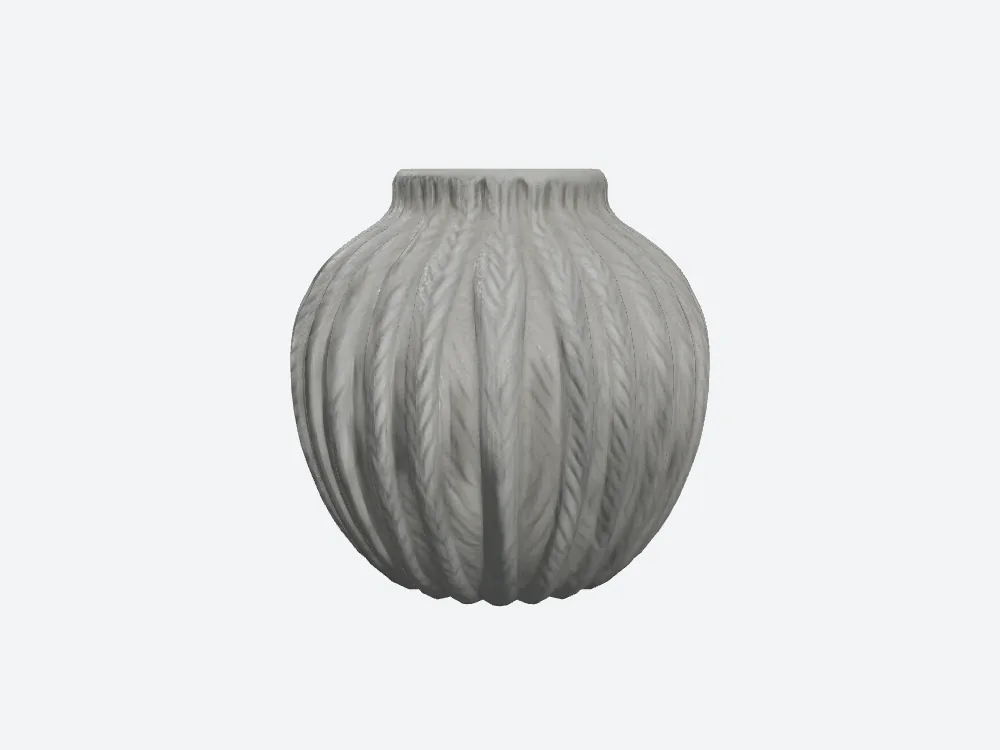
Hyper3D Gen-1.5 PBR front: open neck, rounded belly, mostly longitudinal ribs where the reference has cable crossings.
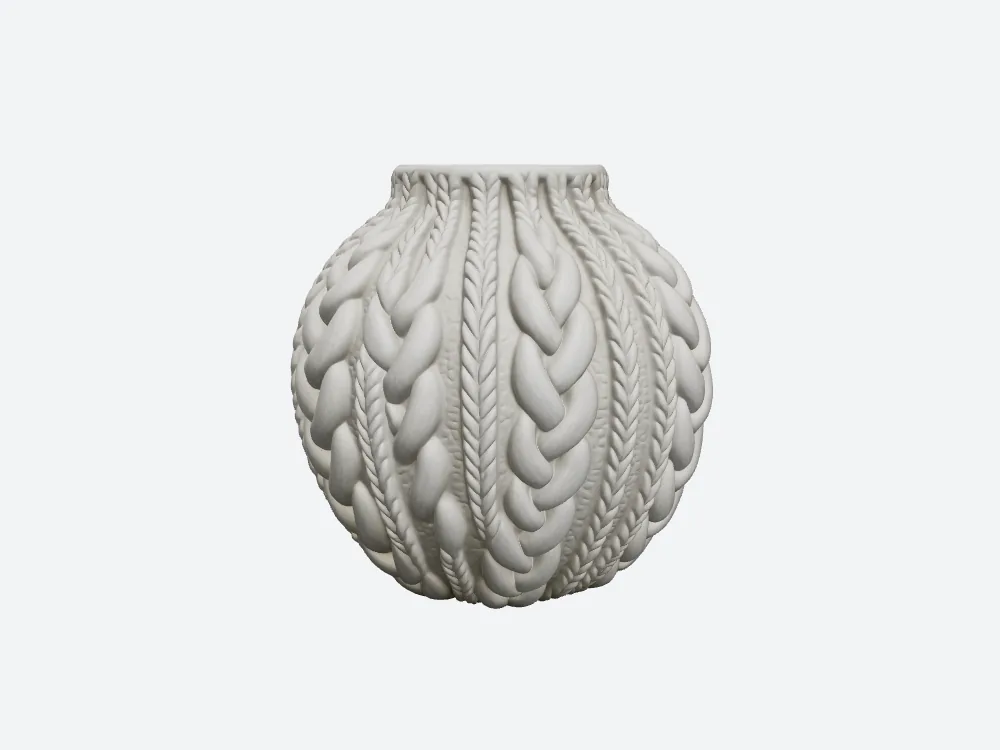
SupaVoxel's matching front: broad raised strands turn across adjacent strands, although this says nothing about watertightness.
The difference is not “one is a vase and one isn't.” Both are plainly vases. The difference is where the eye goes after recognizing the silhouette. Hyper3D gives me repeated upright ribs with small diagonal hints. SupaVoxel gives me large cables whose paths visibly cross. The measured face inventories are 60,000 versus 971,714 triangles. A higher triangle count is not a measured quality multiplier; the visual win comes from where the shape exists, not how many triangles were billed. Hyper3D's smaller file may be exactly right for a ribbed-vase background prop, but it is not as faithful to this particular source motif.
Is that pattern mesh, or merely light on a texture?
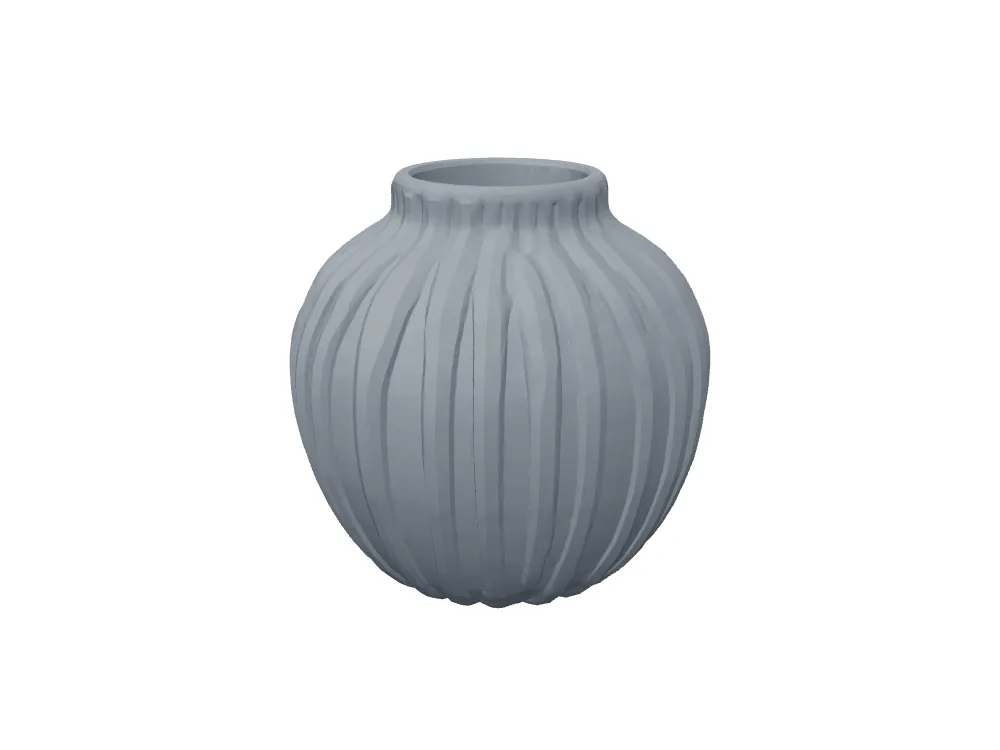
Hyper3D without maps: regular standing ribs remain; most bold crossings do not.
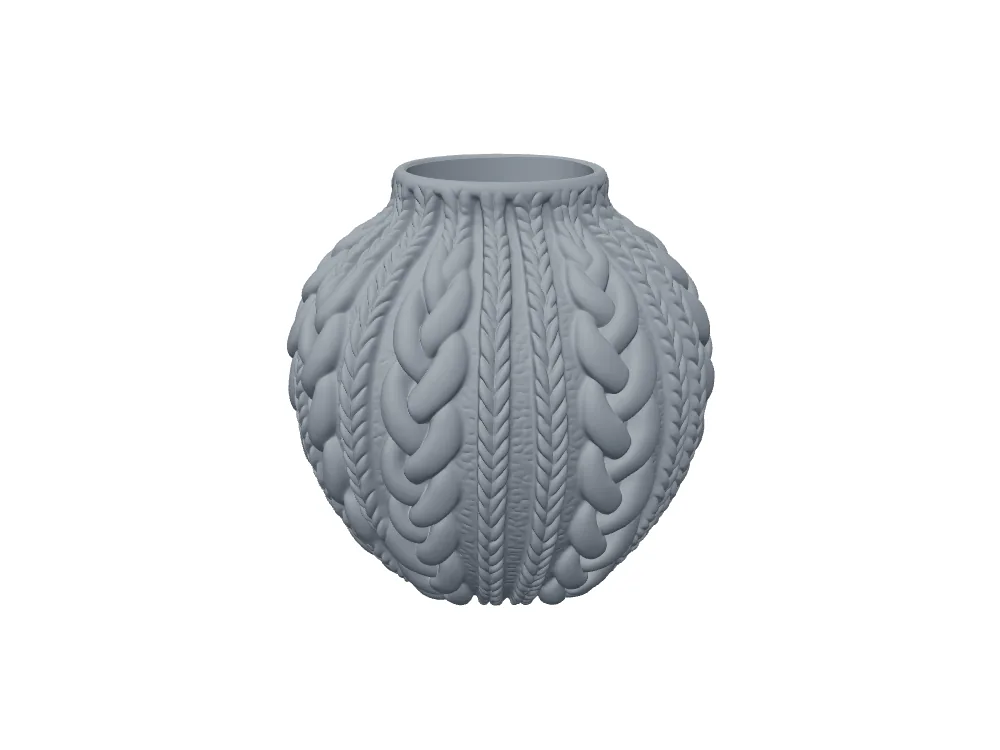
SupaVoxel without maps: thick interwoven cables remain in the actual mesh, despite the file's separate manifold defects.
A normal map can imply a stitch by changing shading. Hide base color, normal and metallic/roughness, and a printable strand must remain as geometry. Hyper3D still has useful ribbing, but many of its small chevrons disappear. SupaVoxel's big over-under forms remain. I did not section them to claim an exact relief depth in millimeters, and I did not print them to prove they emerge from a nozzle. This is a visual mesh-versus-material control. For a turntable, it matters: an object that survives material removal can be relit more honestly. For a simple monochrome print, material alone cannot supply the missing cable contour.
Does the guessed rear continue the design?
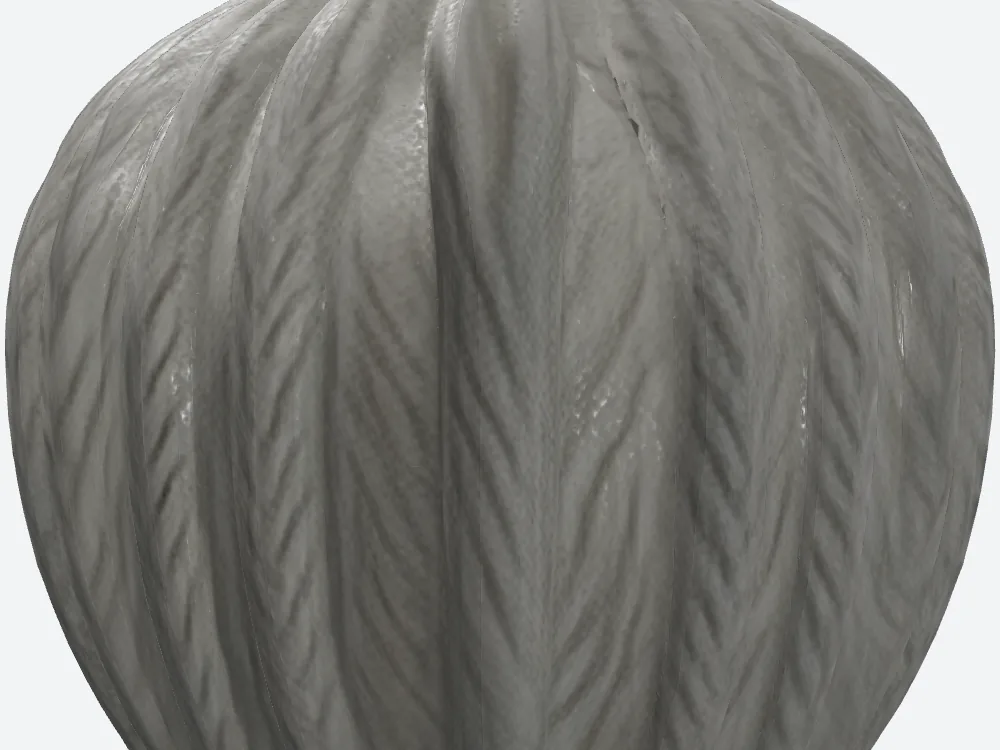
Hyper3D's invented rear repeats straighter ribs with finer cross-stitch-like shading.
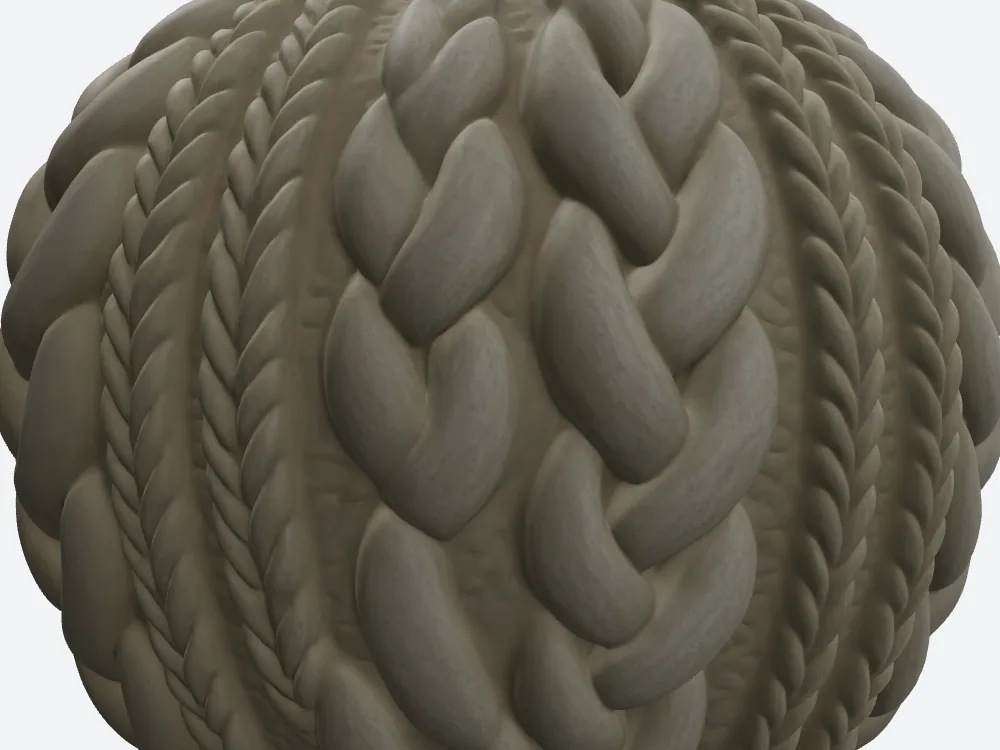
SupaVoxel's imagined back continues the larger raised strand pattern. No reference photo can confirm its exact layout.
The source has no back; neither vendor can win a truth contest back there. For a rotating product model I can still ask whether the invented motif stays coherent as I turn the file. Hyper3D continues its orderly rib scheme. SupaVoxel carries the broad crossings around the body. I prefer the latter for this visual brief because the defining front-side style remains present on the other half. This does not mean SupaVoxel has reconstructed a real maker's backside. A vendor using a single beauty photo should mark unseen surfaces as assumptions, not call any generated rear accurate without a second reference.
Were the maps themselves higher resolution on one side?
No: three 2048 × 2048 PNGs each. Hyper3D's PBR includes base color 2,986,958 bytes, normal 2,734,023, and metallic/roughness 2,506,153. SupaVoxel has base color 4,116,871, normal 1,585,980, and metallic/roughness 1,718,376. Each file embeds a base-color map, a normal map and a metallic/roughness map; different compressed byte lengths do not by themselves imply sharper paint. Hyper3D's non-base-color pair totals 5,240,176 bytes, SupaVoxel's 3,304,356, while SupaVoxel's base-color image is 1,129,913 bytes larger. I did not measure UV-island occupancy or calibrated color ΔE. The white material can shift with lighting, so an apparent warmer or cooler vase is not a quantitative color verdict.
Which Hyper3D file was actually downloaded?
The Hyper3D website sent a 15,869,568-byte ZIP, not a standalone 10.50 MB file. Inside were a 10,496,516-byte PBR GLB and a 5,372,800-byte Shaded GLB. My offline material and geometry numbers use the PBR member. SupaVoxel's authenticated UI delivered a 35,051,872-byte Original size GLB as the exact generated browser Blob, without a local reconstruction. Those are two scopes: 15.87 MB versus 35.05 MB transferred from the product websites; 10.50 versus 35.05 MB if I separately host only their measured PBR GLBs. Hyper3D wins both original-byte comparisons. SupaVoxel displayed Compressed as an alternative, but its size and visual effect were not measured in this case; 35.05 MB is not a universal SupaVoxel file size.
How long would those packages take on a clean phone line?
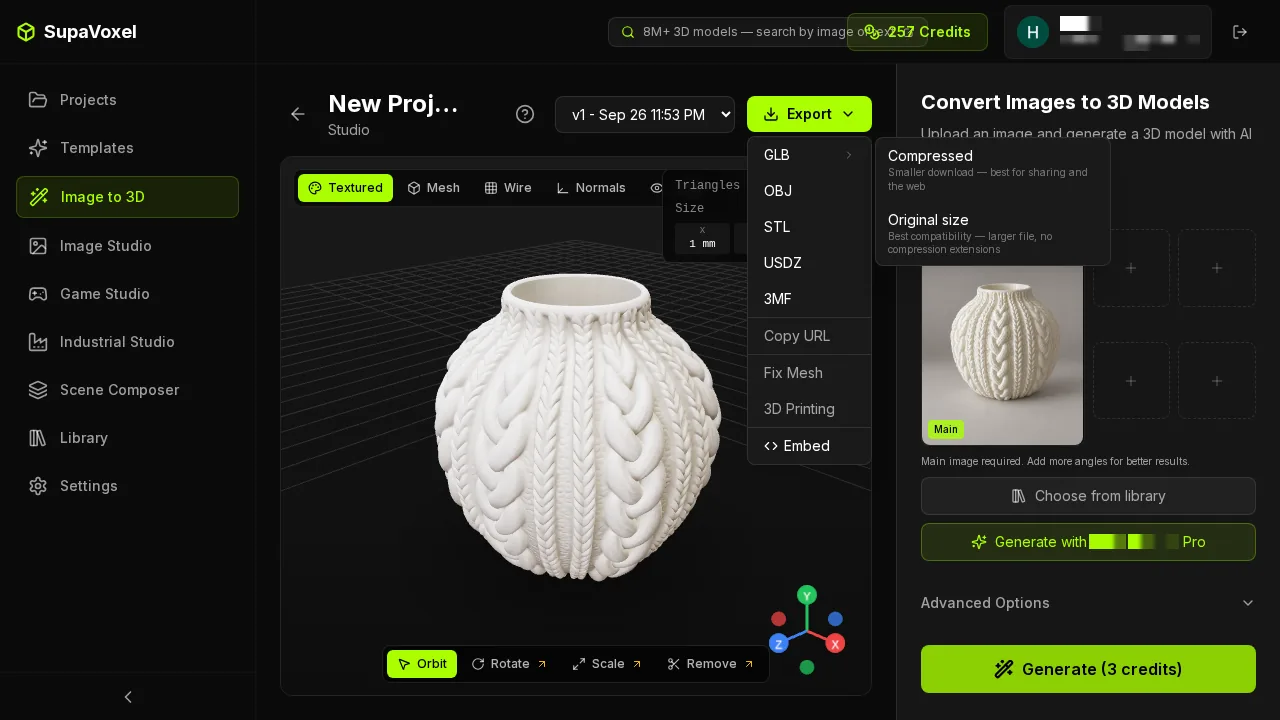
Original size was selected for the measured SupaVoxel GLB; the Compressed item was visible, not downloaded.
At an ideal 12 Mbps with no latency, contention, protocol cost or cache, divide the website-delivered bytes by the line rate: 10.58 seconds Hyper3D ZIP versus 23.37 seconds SupaVoxel GLB. At 100 Mbps, 1.27 versus 2.80 seconds. If only the PBR members were independently hosted, the 12 Mbps numbers would instead be 7.00 versus 23.37 seconds. They are transfer lower bounds, not measured network first-frame times: extraction, GLB parsing, texture upload and rendering are excluded. Hyper3D earns a real delivery win here. SupaVoxel's stronger cable geometry asks me to pay for more bytes unless I optimize and visually check a separate copy.
What does a hundred-asset catalog actually store?
Multiply the two measured standalone PBR GLBs by a hypothetical 100 distinct objects, keeping their sizes identical: 1.050 GB Hyper3D and 3.505 GB SupaVoxel. Multiply the actual original website downloads instead and it is 1.587 versus 3.505 GB. Neither is a measured catalog of a hundred real generated models. At 10,000 full uncached loads, and a hypothetical $0.085 per decimal GB of traffic, those separately hosted original PBR members imply $8.92 versus $29.79 of transfer charge, a $20.87 arithmetic difference. Real CDNs cache, buyers scroll past models and compressors alter files. If my catalog needed the raised knit, I would benchmark a decimated or compressed SupaVoxel derivative—not claim that one already exists or that the original 35 MB must be served to every visitor.
How much geometry memory does the detail demand?
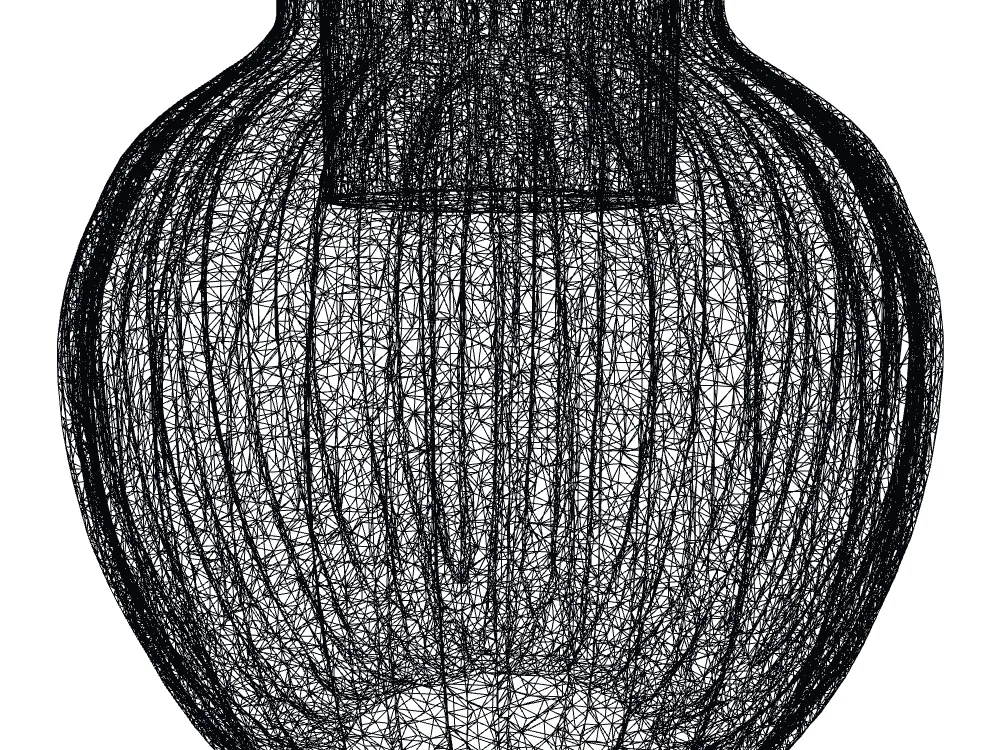
The Hyper3D wireframe is sparse enough to read; legibility is not a substitute for an actual memory benchmark.
With 32 bytes per vertex plus three 4-byte indices per triangle, Hyper3D's 59,614 vertices / 60,000 faces imply 2.63 MB of geometry memory and SupaVoxel's 499,009 / 971,714 imply 27.63 MB. That is an illustrative tenfold geometry-memory exchange, not actual GPU use; neither textures nor decode peaks appear in it. SupaVoxel's mean triangle edge at a 120 mm longest outer side is 0.4410 mm, Hyper3D's 1.5679 mm. The source's chunky knit deserves local geometry, but this global average does not prove an individual groove will print at a 0.4 mm nozzle. A mobile viewer might prioritize Hyper3D's leaner shape; a hero turntable may prioritize the crossing strands.
Is SupaVoxel's stronger shape a usable printing solid?
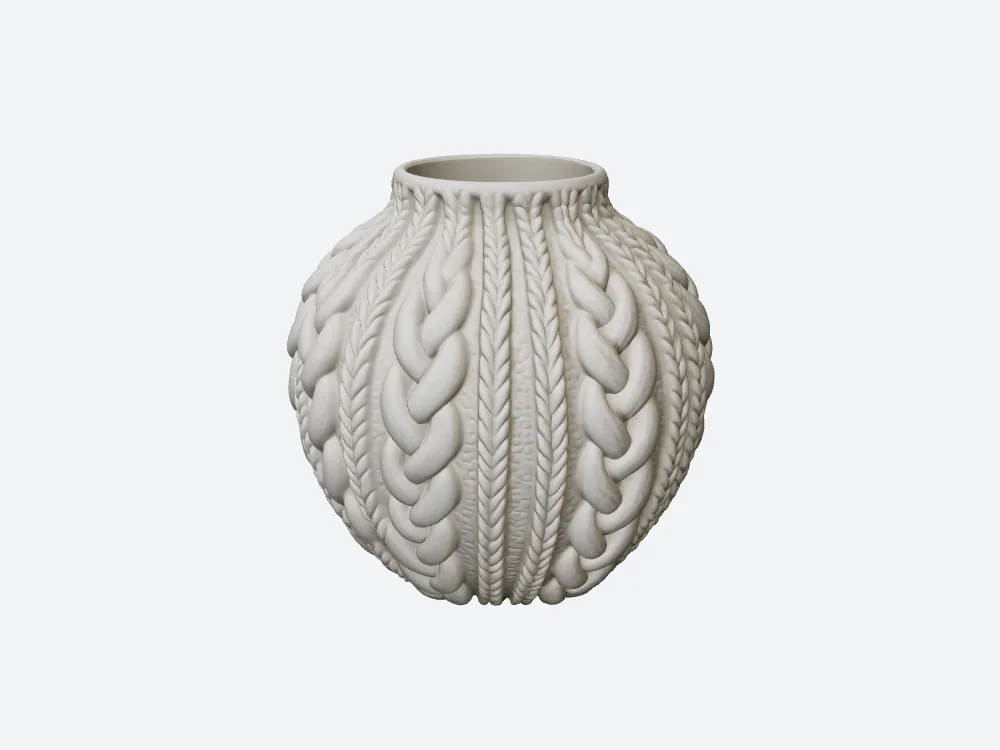
The SupaVoxel hero shows raised interweaving; after UV welding the same file has 497 face-edge regions and 744 non-manifold edges.
No claim of ready-to-print solid is justified. Hyper3D's welded Gen-1.5 mesh is watertight, one face-connected shell with zero non-manifold edges. SupaVoxel's welded export is not watertight, has 744 non-manifold edges and 497 face-edge-connected regions. Those regions touch as one vertex-connected cluster, not 497 detached vases. Its menu lists Fix Mesh, but nobody ran it on this measured export. Hyper3D has 1,416 slender triangles against SupaVoxel's 17, an honest reversal on that narrow hygiene metric. A renderer tolerates defects a slicer may not. This article's SupaVoxel win applies to visual knit design; the shell must be repaired and rechecked before print claims.
What does the mouth conceal on both sides?
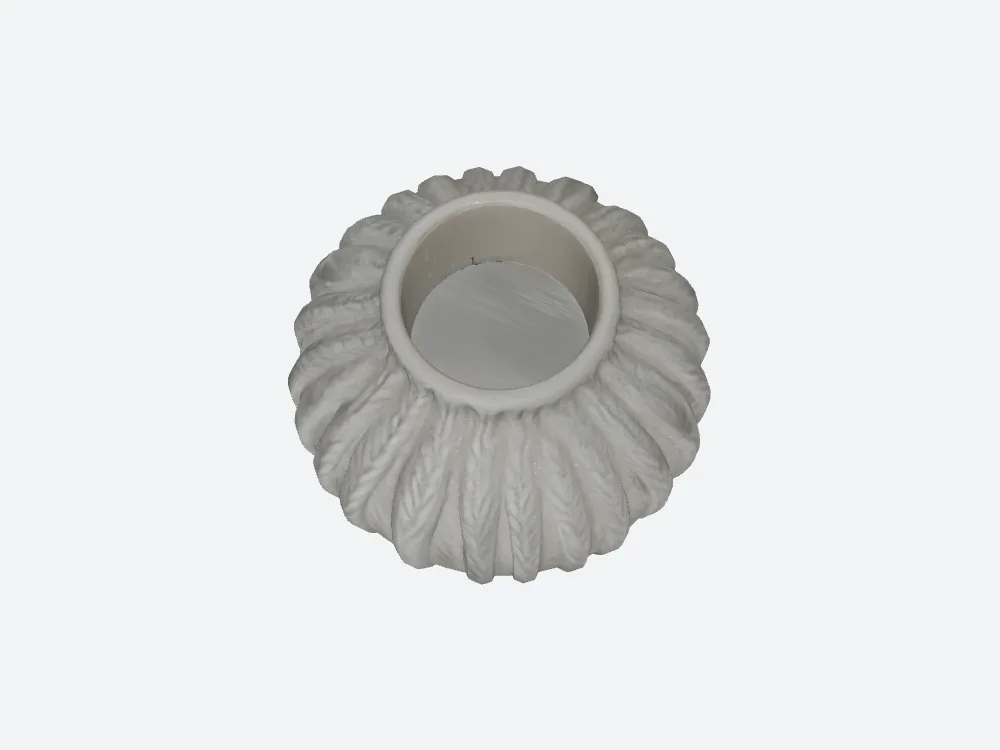
Hyper3D top: an opening with a floor, not a thin-walled cavity reaching the belly.
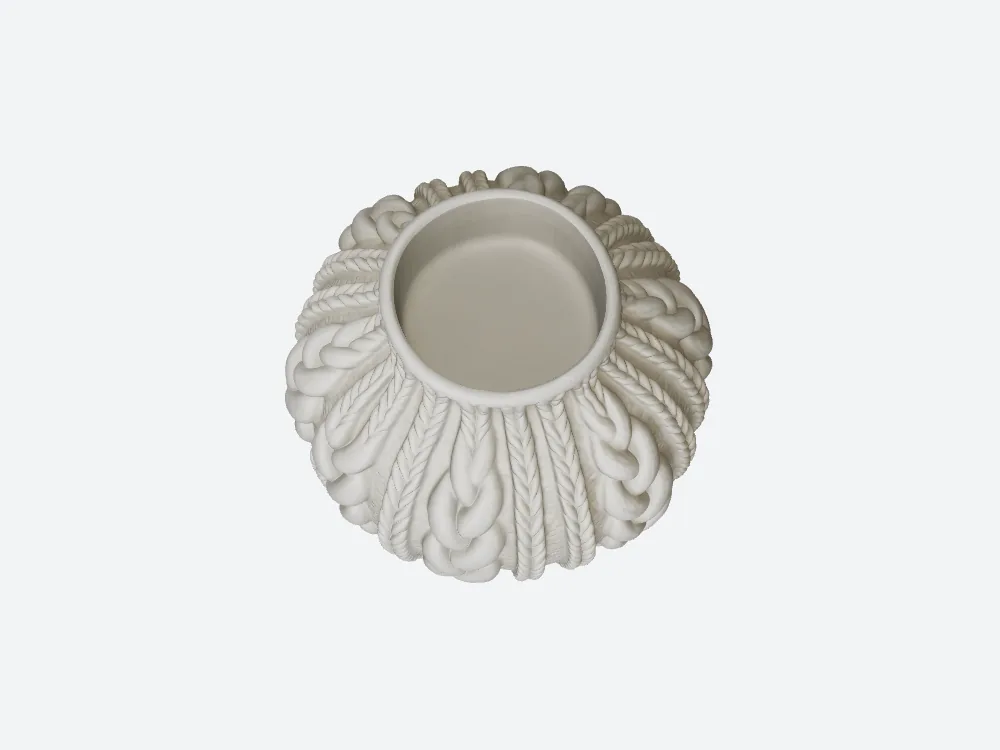
SupaVoxel top: another shallow recess; the photographed mouth did not specify any desired internal depth.
Y-up horizontal sections bracket the Hyper3D recess at 32.79–35.13 mm deep and SupaVoxel's at 22.8–24.0 mm, after each model's longest bbox edge is normalized to 120 mm. Both are mostly solid underneath. SupaVoxel is roughly 9–12 mm shallower despite its more faithful exterior. No print, water fill, leak test or true wall-thickness measurement was performed. Hyper3D's valid closed solid permits conditional volume/resin arithmetic; SupaVoxel's non-manifold export does not permit a trustworthy solid-fill resin price here. For an actual flower holder, redesign the interior on both files rather than let photogenic cable strands settle the engineering.
Final verdict: which compromise suits this job?
Hyper3D Gen-1.5 gives me 10.50 MB of standalone PBR, a much smaller 15.87 MB original ZIP transfer, and a single welded watertight starting shell. It gives up much of the thick photographed cable crossing. SupaVoxel's 35.05 MB Original size GLB makes those large strands as raised geometry and continues them around the imagined rear, but carries 744 non-manifold edges, 497 face-edge regions and a shallower recess. For a design-matching digital concept I favor SupaVoxel; for an unchanged print file I would reverse that choice. There is no measured ΔE, UV efficiency, web-viewer first-frame time or waterholding result to break the trade universally.
Use SupaVoxel when the relief must be geometry
I would take SupaVoxel as the knit concept sculpt, then repair its junctions, validate the new mesh and optimize a separately measured web copy if a catalog must load quickly. For a lightweight background object or an initial single-shell shape, the downloadable Hyper3D Gen-1.5 vase is an honest alternative—with ribs rather than the pictured bold weave. Neither file should be sold as a leak-tested flower vessel from these data.
How I kept the numbers in their proper scopes
The same SHA-checked source PNG went into both products. Measured triangles, vertices, texture roles and sizes came from the downloaded Gen-1.5 Hyper3D PBR ZIP member and SupaVoxel Original size UI GLB; Gen-2.5 was preview-only on Free. Offline paired views used matched camera/light settings without claiming pixel-perfect registration or calibrated color. ZIP delivery and hosted PBR member are deliberately separated. Bandwidth, hypothetical CDN charge and illustrative geometry memory are arithmetic under explicit rates/layout, not device tests. UV seams were welded before topology checks, and 120 mm refers to the largest bounding-box edge, not automatically to height. Cavity figures bracket modeled sectional contours; none proves liquid containment or physical printability.
Originally published on Medium: Hyper3D 3D Vase Review 2026: 10.50 MB, Mostly Straight Ribs.